More than a person's age.
Frailty is a clinical state of increased vulnerability: the body has less reserve across multiple systems, making everyday challenges or acute illness harder to withstand.
Two people of the same age can differ greatly in their health and function. Frailty describes vulnerability that age alone does not capture. Assessment helps clinicians understand how someone may respond to a stressor, such as an infection, a fall, or a medical procedure. [1]
Frailty is associated with a higher risk of falls, worsening disability, hospitalization, and death. Recognizing it can add useful information to discussions about treatment, recovery, and support. [2]
Five domains of physical frailty.
The Physical Frailty Phenotype, developed by Fried and colleagues, is one established approach. It evaluates five domains rather than relying on appearance alone. [2]
Unintentional weight loss
Weight loss that was not planned.
Exhaustion
Self-reported low energy or difficulty getting going.
Low physical activity
Reduced activity assessed using a standardized measure.
Slow walking speed
Walking performance measured over a defined distance.
Reduced grip strength
Muscle weakness assessed with a grip-strength test.
Under this phenotype, one or two criteria indicate prefrailty; three or more indicate frailty. Formal assessment uses specified questions, measurement protocols, and thresholds. The descriptions above explain the domains; they are not a self-scoring diagnostic tool. [2]
Frailty, disability, and chronic disease are related—but distinct.
Frailty concerns vulnerability and reduced reserve. Disability concerns difficulty performing activities. Comorbidity means having multiple health conditions. These can overlap, but one does not automatically establish the others. Frailty can precede disability; disability can also arise for reasons unrelated to frailty. [2]
Studying what lies beneath.
Frailty research connects changes in physical function with the biology of aging. Reduced strength, altered energy balance, and lower activity can interact, helping explain why researchers study several physiological systems together. [1]
At the Abadir Lab, we investigate inflammatory and metabolic pathways, mitochondrial biology, and molecular markers—including circulating cell-free DNA—to understand differences in frailty. We also study how these measurements relate to functional signals such as gait and speech.
The aim is to understand biological differences among people with frailty and develop better ways to assess vulnerability and guide future interventions.
Explore our research areasResearch overview: Abadir Lab AI & Aging. Watch the original cellular and molecular animation below.
Assessment informs a personal plan.
Frailty assessment is one part of understanding an older adult's health. It can support conversations about goals, daily function, medical conditions, and the help a person may need during treatment or recovery.
Johns Hopkins guidance emphasizes recognizing changes early, staying physically active, eating well, and maintaining social connections. Strength and mobility activities should be suited to the person's health and abilities. Nutrition and the management of chronic conditions also deserve attention. [4]
Read the Johns Hopkins patient guideSee frailty explained.
Four animations from the original Abadir Lab frailty resource, created for clinicians and healthcare workers outside geriatrics.
What is Frailty?
An introduction to vulnerability, reserve, and why frailty matters.
Watch on VimeoWhat Does Frailty Look Like?
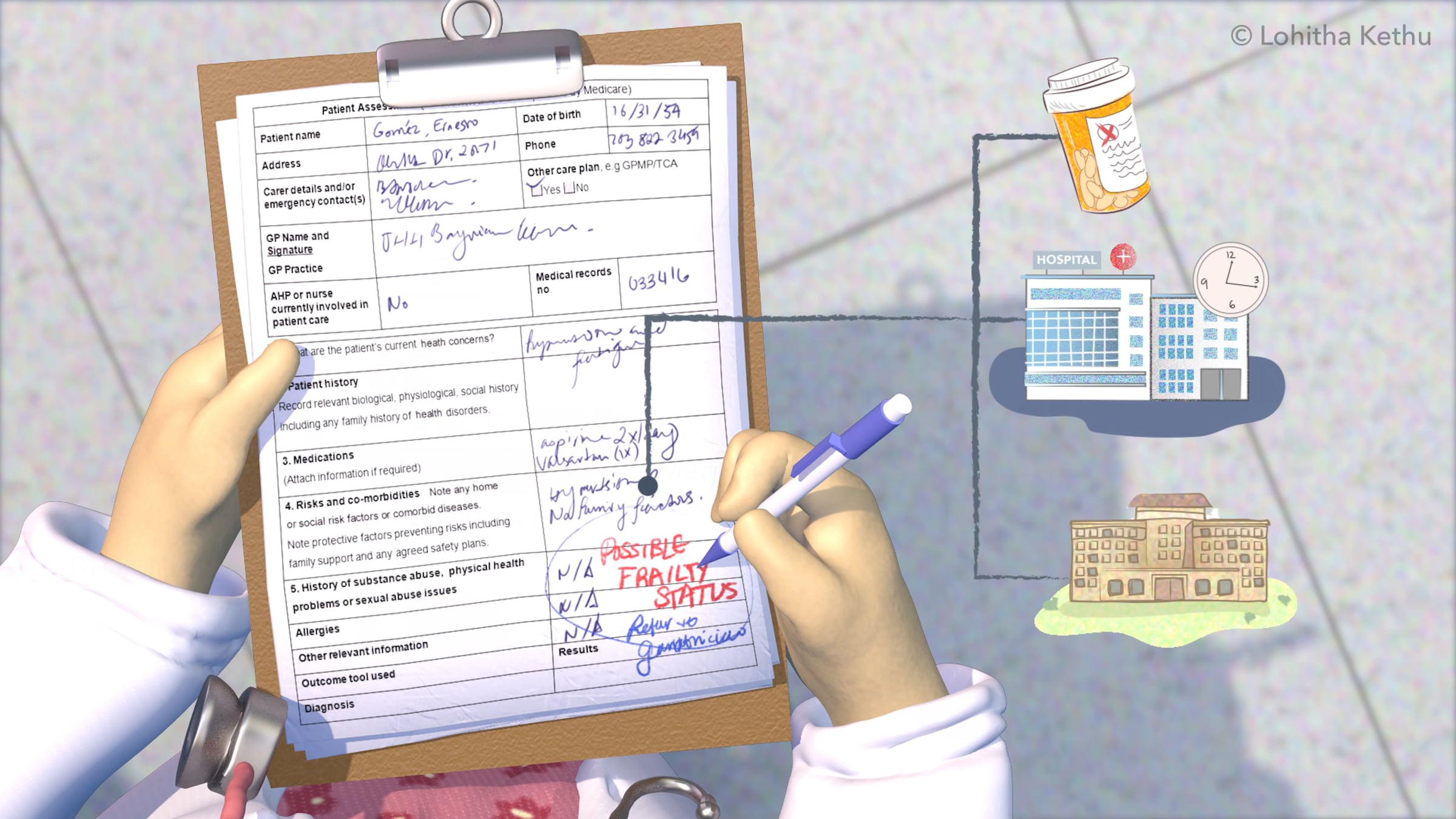
Meet Ernesto and follow the assessment of physical frailty.
Watch on VimeoCellular and Molecular Changes in Frailty
Explore the biological processes discussed in the original series.
Watch on VimeoAnimation credit: Original artwork credited to Lohitha Kethu; videos hosted by Lohitha Kiran on Vimeo. Created as part of a Johns Hopkins Medical and Biological Illustration master's thesis. Videos and stills are from the original educational series. Visit the original video collection ↗
Sources & further reading
This guide adapts the Abadir Lab's original What is Frailty? and Frailty Measures pages, with references for the clinical concepts described here.
- Xue QL. The frailty syndrome: definition and natural history. Clinics in Geriatric Medicine. 2011;27(1):1–15. Read on PubMed ↗
- Fried LP, et al. Frailty in older adults: evidence for a phenotype. The Journals of Gerontology: Series A. 2001;56(3):M146–M156. Read on PubMed ↗
- Bandeen-Roche K, et al. Frailty in older adults: a nationally representative profile in the United States. The Journals of Gerontology: Series A. 2015;70(11):1427–1434. Read on PubMed ↗
- Johns Hopkins Medicine. Stay Strong: Four Ways to Beat the Frailty Risk. Read the patient guide ↗